
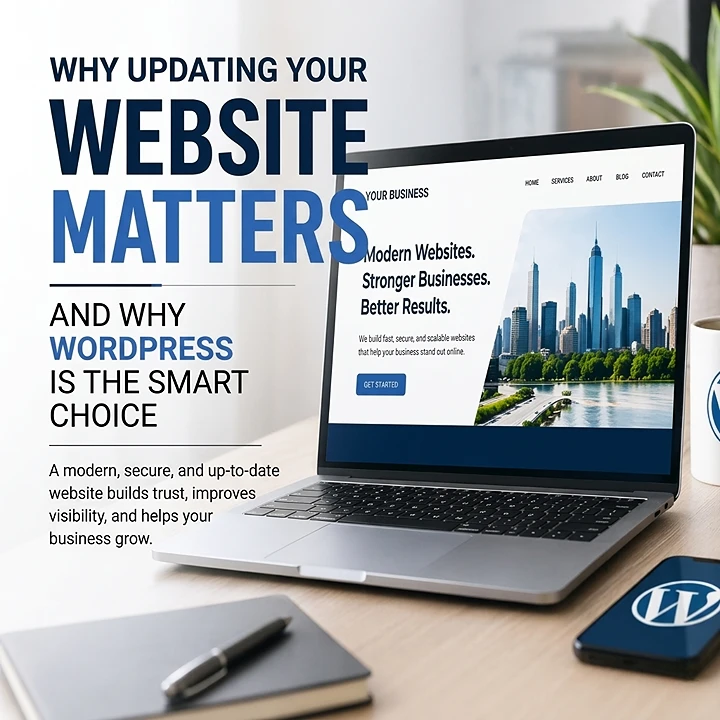
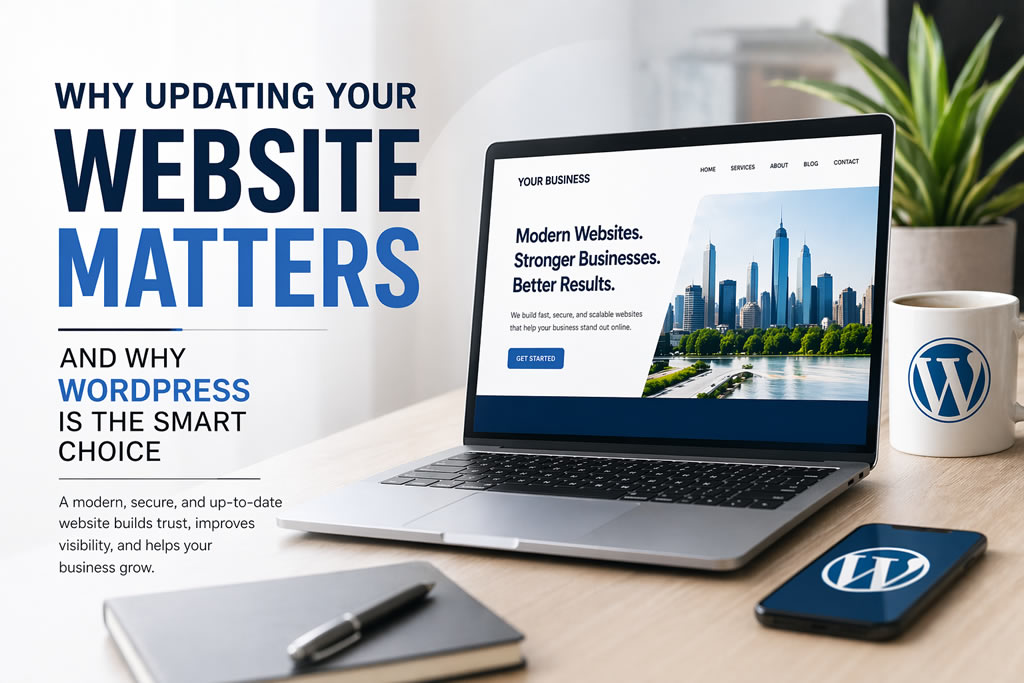
 Why Every Business Should Regularly Update Their Website (and Why WordPress Is the Smartest Platform to Use)
In today’s digital-first world, your website is often the first impression your business makes. And like any first impression, it needs to be current, fast, and professional. Yet many businesses still operate with outdated websites that no longer reflect their brand, services, or customer expectations.
Keeping your website updated—and ideally built on a flexible platform like WordPress—is no longer optional. It’s a competitive necessity.
1. Your Website Is Your Digital Storefront
Think of your website as your 24/7 storefront. If it looks outdated, loads slowly, or feels difficult to navigate, customers assume your business operates the same way.
Modern users expect:
- Fast loading speeds
- Mobile-friendly design
- Clear navigation
- Up-to-date content
If your website doesn’t meet these expectations, visitors will leave—often within seconds.
2. Outdated Websites Hurt Trust and Credibility
Design trends, user expectations, and technology evolve quickly. A website that hasn’t been updated in several years can unintentionally signal that your business is inactive or behind the times.
Even if your services are excellent, an outdated site can create doubt before a customer ever contacts you.
Regular updates help you:
- Reinforce professionalism
- Build trust with new visitors
- Show that your business is active and growing
3. Security Risks Increase Over Time
One of the most overlooked risks of neglecting website updates is security.
Older websites—especially those built on outdated systems—are more vulnerable to:
- Malware attacks
- Plugin vulnerabilities
- Data breaches
Platforms like WordPress regularly release updates that patch security issues. Keeping your site updated significantly reduces your risk exposure.
4. SEO Performance Depends on Freshness
Search engines prioritize websites that are:
- Regularly updated
- Technically optimized
- Mobile responsive
- Fast-loading
If your website hasn’t been updated in years, your search rankings can slowly decline—even if your content is good.
Updating your website improves:
-
- Visibility on Google
- Organic traffic
- Local search performance
5. Why WordPress Is the Best Platform for Most Businesses
One of the biggest reasons businesses migrate or rebuild their websites is flexibility—and this is where WordPress stands out.
WordPress powers a large portion of the web because it offers:
Flexibility – You can build anything from a simple brochure site to a full e-commerce platform.
Easy Content Updates – Business owners can update pages, blogs, and images without needing a developer.
Scalability – Your website can grow as your business grows without needing a full rebuild.
Strong SEO Capabilities – With the right setup, WordPress gives you full control over SEO optimization.
Huge Plugin Ecosystem – You can add features like booking systems, contact forms, analytics, and more.
6. A Website Should Evolve With Your Business
Your business is not static—your website shouldn’t be either.
As your services expand, branding changes, or customer expectations shift, your website should reflect that growth. Treating your website as a living asset—not a one-time project—is key to staying competitive.
Conclusion
Updating your website isn’t just about design—it’s about performance, security, visibility, and credibility. Businesses that consistently maintain and modernize their websites stay ahead of competitors who don’t.
And when it comes to building a scalable, easy-to-manage, and future-proof website, WordPress remains one of the strongest choices available.
If your website hasn’t been updated in years, now is the time to rethink it—not just as a digital brochure, but as a core business tool that drives growth.





https://shorturl.fm/iZ1Q5
https://shorturl.fm/aCRls
https://shorturl.fm/eMGnJ
https://shorturl.fm/pMG84
https://shorturl.fm/G1f7v
https://shorturl.fm/rD05i
https://shorturl.fm/kr87U
https://shorturl.fm/4FkMa
https://shorturl.fm/TVmSU
https://shorturl.fm/j2MtE
https://shorturl.fm/syR03
https://shorturl.fm/LDKNo
https://shorturl.fm/ooFoE
https://shorturl.fm/vEXre
https://shorturl.fm/eGtHe
https://shorturl.fm/Sz0hv
https://shorturl.fm/YMXXe
https://shorturl.fm/5UgzH
xrnipondqsuhjvdzdxvodduxsjjojp
https://shorturl.fm/Am43w
https://shorturl.fm/TrBHJ
https://shorturl.fm/Bz7xF
https://shorturl.fm/KcNnY
https://shorturl.fm/4O1wK
https://shorturl.fm/el5jQ
https://shorturl.fm/U2AxT
https://shorturl.fm/cdWbx
https://shorturl.fm/ZTfAy